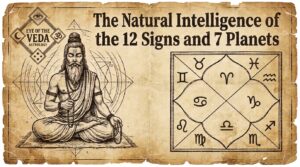
In Jyotish (Vedic astrology), just as every planet has its own unique light that it shines from above, each planet has its own way of finding the truth. Each planet and zodiac sign possesses its own distinct form of intelligence that it uses to navigate life and uncover truth.
By understanding the elemental makeup of your birth chart—specifically your Atmakaraka (soul planet) and the signs where you hold strong planets—you can decode your own mentality and better understand the people around you.
In this excerpt from my Jyotish course, I breakdown the natural intelligences of the four elements across the zodiac signs, followed by how the five elements manifest through the planets. I share some key points below but check out the full class here:
1. Fire Sign Intelligence: True Intuition & The Moral Compass That Merits Leadership
Core Intelligence: Fire signs carry a direct intuition. Fire symbolizes intuition.
How It Works: While the word “intuition” is used far too loosely these days, true intuition is direct knowing without relying on the physical senses. People with strong fire placements simply know how things are meant to be and they trust that.
Kshatriya Varna/Caste Archetype: Fire signs represent the Kshatriya (warrior) mentality. In Vedic philosophy, a true warrior is defined by an innate moral compass, an unshakeable internal sense of right and wrong that does not need to be taught. Fire signs make the best rulers and leaders because fire signs are innately more focused on right and wrong, and upholding what is good and dharmic. The role of the warriors are to protect everyone else, especially the Brahmins.
Core Intelligence: Earth signs carry a rational, analytical, and academic type of reasoning.
How It Works: Because the earth element is a mixture of the elements, earth signs possess the most balanced and mixed type of intelligence. Like how we refer to people as “grounded”, “solid”, or “down to earth”. These types like to play by the rules. They rely on tangible proofs and do not like to speculate too much. Because of this, Earth signs can suffer from being too rational at times. They may ignore what their gut or body is telling them simply because an article, study, or logical framework claims something is safe or correct.
3. Air Sign Intelligence: Unique Intellectual Perspective
Core Intelligence: Air signs are those that are meant to carry a unique intellectual perspective based on their own sense experience, powered by the prana that moves through their senses. They express the most individualized intellectual perspectives and can be masters of ideation.
How It Works: Air signs generate unique intellectual perspectives shaped heavily by their own personal background experiences and environment. These are the types that are naturally social, political, and artistic, thriving on the exchange of ideas and different perspectives.
The Challenge: Associated with the Vata (wind) dosha and desire, air is unpredictable and erratic. Wind just blows when it blows, and is unpredictable and irregular by nature. Because air signs believe their unique perspective is how the world should operate, they can experience frustration or unhappiness when others do not share their exact viewpoint, and typically waste a lot of time in social issues that they likely have no real impact on. There can be too much emphasis on relationships and socializing in general, causing one to lose ones own sense of self and dharma. Here we see why Air signs are the opposite of the fire signs, the signs naturally oriented to pursuing inspiration, dharma, and purpose.
4. Water Signs: Emotional Intelligence & Impressions
Core Intelligence: Water signs operate emotionally, and work through Samskaras (feelings and subtle impressions).
How It Works: Ruled by the watery nature of the Moon—the storehouse of our impressions—water signs are deeply feeling-oriented. Rather than relying on logic, they absorb emotional impressions effortlessly, much like a mother instinctively sensing when her child is hiding something. Water signs are the type that can read everything through someones body language or tone, and can also express everything they without words, and tend to speak the least of all the signs actually. Water signs learn by osmosis.
Part 2: The Five Elements Through the Planets
While the signs operate through four elements, the planets introduce a fifth element: Ether (Akasha or sky). Examining the elemental strength of your planets reveals deeper layers of your intellect, temperament, and even your physical constitution.
Ether (Akasha / Jupiter): Grants an exceptional memory, a deep love for knowledge, and a calm demeanor. Strong ether types make great listeners, value open space in their lives, and often have a taller, lighter physical build that can tire easily.
Air (Vata): Bestows sharp wit, cleverness, and a life full of unique experiences. Air-dominant individuals live in the moment and are highly social, though their energy and physical traits tend to be drier, thinner, and more changeable.
Fire: Produces a “hot-natured” constitution with a fast metabolism, strong digestion, and a higher tolerance for intoxicants. Intellectually, planetary fire fuels intense vision, powerful oratory skills, and a voracious appetite for reading and consuming knowledge.
Water: Manifests as a placid, nurturing, and cohesive attitude that attracts many friends. Water-dominant people are emotionally expressive, responsible, and skilled at bearing burdens, often displaying softer, rounder physical features and higher water retention.
Earth: Brings stability, balanced physical proportions, and an appreciation for material happiness and pleasant sensory experiences (like fine fragrances). Strong earth placements help a person enjoy being in the world and accumulate good merit.
How to Apply This to Your Chart
Look at your Atmakaraka (the planet with the highest degree in your chart, only counting the classic planets, Sun-Saturn). Whatever planet that is, you automatically carry the type of intelligence and elemental qualities associated above. Also look at any planets placed in their own signs. The element associated with those planets will highlight your primary mode of intelligence—whether you navigate truth through fiery intuition, earthy logic, airy intellect, watery empathy, or etheric wisdom.
Why does Rohini nakshatra have a snake yoni? And how do we use nakshatra yonis? And why is Mrigashira also given the snake yoni? In this detailed excerpt from the nakshatra course, currently on my patreon, I explain the common misunderstandings about nakshatra yonis.
I share the mythological origins and deeper meanings behind the Rohini and Mrigashira nakshatras in Vedic astrology. This 10 minute video challenges modern oversimplifications that are found all over youtube and instagram these days. In this video I explain how we can more accurately apply the nakshatra yonis, and why Rohini nakshatra and Mrigashira nakshatra have a snake yoni.
1. Misunderstandings Around Nakshatra Yonis and Animal Symbols
Nakshatras in Vedic astrology are each associated with a yoni (a sanskrit word that literally means “vagina” or “birth canal”), often represented by animals. Modern popular content, especially on platforms like YouTube, has misinterpreted or exaggerated these animal associations, leading to confusion and superficial interpretations. This has happened to such an extent that people will think of Rohini when they think of a snake yoni, or Mrigashira, but not even think of Ashlesha nakshatra, the star ruled by the Serpent Devas, or Scorpio, the sign of serpents.
The concept of nakshatra yoni originated within medieval arranged marriage systems. This is called the “kuta” compatibility points system.
Yonis describe each partners sexual reproductive compatibility as symbolic animal types (snake-like, horse-like, elephant-like vaginas).
This system could be said to be chauvinistic, medieval, and a very “kali yuga” part of jyotish. This was only used for arranged marriages.
Many modern interpreters mistakenly treat nakshatras as literally symbolized by their yoni animals (e.g., Rohini as a snake nakshatra, Jeshtha as a deer nakshatra).
This results in over-romanticized and misleading interpretations, sometimes ignoring the deity or cosmic role associated with the nakshatra.
Occasional valid symbolic overlaps exist (e.g., Ashwini nakshatra’s association with horses matches its horse-like yoni), but such instances are exceptions, not the rule.
2. The Snake Yoni of Rohini: Symbolism and Contradictions
Rohini nakshatra’s yoni is traditionally represented as a snake. This association, however, contrasts sharply with Rohini’s bold astrological energy and symbolism. In this video I explain how:
Rohini is ruled by Brahma, the Creator deity, embodying fertility, growth, and creation, the opposite of snake like energy.
A snake as Rohini’s yoni is paradoxical because snakes symbolize qualities opposite to Rohini’s energy—associated with Scorpio-like intensity, lust, sexuality, and trapped desires rather than growth and creativity, and the tendency to be always moving and growing.
Interpreting Rohini purely through the snake metaphor leads to contradictions and misrepresentations of personality traits and life patterns.
3. The Mythological Narrative Explaining Rohini and Invaka Nakshatras
The mythology connecting Rohini, Mrigashira (also called Invaka), and Ardra reveals their deeper cosmic and psychological significance beyond the simplistic animal symbolism:
Brahma created the world and all women, including Sarasvati, whom he regarded as a daughter but also lusted after.
Sarasvati fled, transforming into various animals to escape Brahma’s inappropriate pursuit. She eventually took the form of a swift deer.
Brahma took on a deer form and pursued her relentlessly across realms.
Shiva (Rudra/Ardra nakshatra) intervened by decapitating Brahma to stop this violation.
Shiva then placed the heads (his own and the deer’s) in the stars, forming the mrigashira nakshatra.
This myth explains the connection between Rohini, Mrigashira, and Ardra nakshatras, linking lust, pursuit, and the cosmic order that Shiva sets right.
4. Spiritual and Symbolic Meaning of the Snake as a “Trapped Form”
The snake yoni of Rohini and Mrigashira embodies sexuality, lust, and entrapment rather than the positive creation symbolism. Thats because while Rohini and Mrigashira have their own positive symbolism and agendas, on the sexual level they can be very trapped and venomous:
The Snake form symbolizes trapped sensual energy and an intense preoccupation with sexuality.
According to spiritual masters and teachings (such as from Avatar Meher Baba), incarnating as a snake relates to karmic consequences of excessive lust and being spiritually trapped in sexual obsession.
Brahma’s attempted violation and Shiva’s intervention underline themes of sexual excess, violation, and cosmic correction.
Shiva, with snakes coiled in control (symbolizing yogic mastery over lust), contrasts Brahma’s uncontrolled desire.
Rohini and Mrigashira nakshatras carry a stigma related to violating sexual norms or being excessively driven by sexual impulse—hence their snake yoni.
5. Cautions for Modern Practitioners and Astrologers
I stress care in applying the yoni symbolism in modern astrology:
Avoid oversimplified or sensational animal associations to describe nakshatras.
Remember that actual nakshatra meanings are deeply intertwined with their ruling deities, mythologies, and spiritual lessons. If they are not, they may not be correct meanings. Test them out on many charts before integrating them into your practice.
For snake symbolism, the Ashlesha nakshatra is more appropriate as a pure “serpent” star, rather than Rohini or Invaka.
Modern media and popular YouTubers often exaggerate or distort these symbols, leading to misinformation. Its understandable as the sexual connotations of a yoni make this category perhaps more appealing and colorful than the others.
Check out the full video here and let me know what you think in the comments.
Keep in mind this is just an excerpt from the nakshatra course, in the other classes I give thorough examples of what I am explaining here. The full course comes with a manual so long and detailed that it had to become a 432 page book. Get The Nakshatra Manual here on amazon, and read about it here for more information
J. P. Morgan had a Jupiter-Mars conjunction in his chart, one of the other classic yogas for wealth and prosperity
Financial Astrology is the secret investing tool that they don’t want you to know about. By “they” I mean the old families, the bankers, and the 1%ers of the world that own almost everything already, and yet still want more. These families are very old and are older than christianity. They are not into Christianity, even if they seem to be outwardly. Their family religions go back to Greece, Egypt, and Babylon before that. These were all astrological cultures. This is why the elite are still very much into Astrology as their religion, and also as a way to make more money and get more fulfillment out of all areas of life. It seems the more successful and powerful a person is, the more likely they are to believe in and use astrology in their personal life, and yet Astrology is never talked about in the mainstream world in a serious way. It almost seems intentional doesnt it?
According to Astrologer Evangelene Adams in her biography Bowl of Heaven, the great financial juggernaut, J. Pierpont Morgan, was an avid client of hers. She claimed that he subscribed to her planetary reports for many years and that she even taught him astrology in the later years of his life.
Recent disclosures of the epstein files have shown that Epstein and his billionaire buddies actually have “house astrologers” as they say. These are in house astrologer hired to work just for them, whenever they please.
So if the billionaire class are using Astrology, and gaining from it, it now makes sense why astrology is something that is not really encouraged for the mainstream in the very media and news corporations that these elite people own. They want to hide it from you. The crazy thing is how simple of a branch of astrology it can really be too! Its actually a lot easier to do financial astrology and get acceptable results than it is to do a lot of other branches like medical astrology or predictive natal astrology.
Thats why one of the most empowering things you can do for yourself is to learn Astrology. In doing so you come to understand the mind of the Creator itself and harmonize with the universal built in guidance system that nature already provided. This study will help you in all areas of life, but one of the most fun ways to see it is when it brings you financial abundance. For this reason I really encourage the study of financial astrology. I had studied other branches of astrology for years, but it was not until 2020 that I began to study financial astrology. By using astrology to invest and make more money than I had ever made doing anything else, it really showed me how powerful this knowledge is, and made me even more appreciative of it.
Since that summer of 2020 when I began seriously studying financial astrology, I have learned a lot. I have made plenty of mistakes, but also nailed numerous all time highs of Bitcoin from months beforehand, with only one shot.
I have now compiled all my financial astrology classes into one big course over at my patreon. Its available to all the patrons at the Udaya Jyotisha tier and the premium level. If you join the financial astrology patron you also get a frequent forecasts on the crypto markets and mundane factors in general. Check out the course here:https://www.patreon.com/collection/643023?view=expanded
Avasthas Are The Foundation of True Vedic Astrology
The jagradaadi avasthas are a great place to start with Vedic Astrology, and I just finished teaching a course on them over on my patreon. They are a systematic, scientific set of techniques that are wonderful for all branches of astrology. In this course I show how they can be used in predictive astrology, in psychological astrology, in medical astrology, and in financial astrology.
I know that this term jagradaadi avastha is a mouthful of sanskrit so let me break down what this phrase means and why it is important. An Avastha is a condition or state something is in. Jagrad or jagrat means “wide awake”, and the “aadi” suffix means “etc.”. So the phrase jagradaadi avastha means “the wide awake, etc. conditions” and refers to three conditions that planets can fall in where they are either wide awake, dreaming, or in deep sleep. And what is amazing is the planets seem to show up or not show up in the persons life based on this. For example if the Sun is wide awake in the chart, the person will be awake to be the Sun in all areas of life. They will be a great leader, be consistent, responsible, magnanimous, etc. If the Sun is asleep in the chart, they will more likely be asleep to the need for being responsible, consistent, a great leader, etc.
We start to see the planets really come through in a person when they are awake, almost like the person is an incarnation of that graha. When the planets are dreaming one is able to use that planet a little more than half the time, and when in an asleep state the planet is not going to be used much at all. The native is then asleep to the value and needs of that planets agendas.
The Jagradaadi avasthas are a very important component of Parashari Jyotisha. From studying this course you will have a formulaic way to interpret the strength of any planet in any sign, and in any varga. As such it is a great foundational class for beginners to take because you know have a formula for interpreting any planet in any varga. This course also comes with a handy 18 page manual on the jagradaadi avasthas to help you study.
You can purchase this course for $39 USD or it comes with the patreon membership, which is currently $33usd/month. WIth the patreon membership you also get access to all of my other courses, a free monthly forecast video for each rising sign, and discounts on one on one tutoring and mentorship. Check it out here https://www.patreon.com/collection/2276101?view=expanded
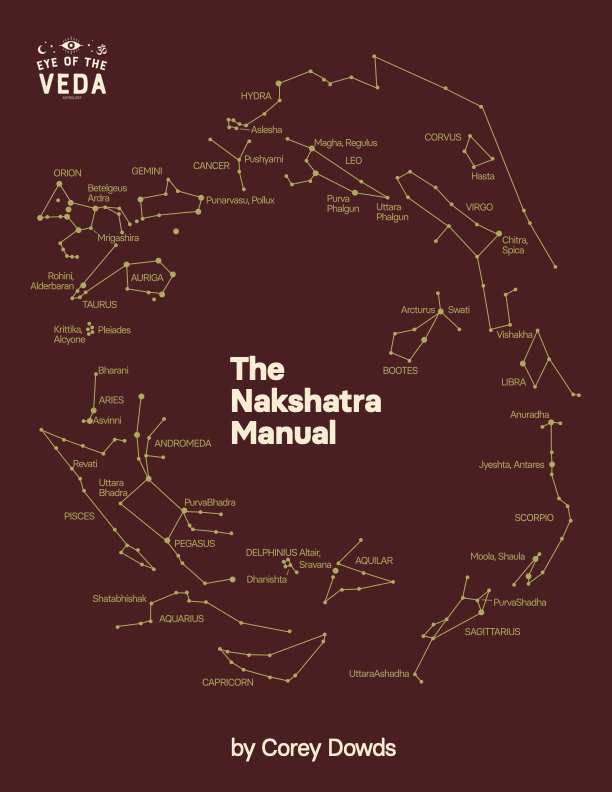
My book is finally done. The Nakshatra Manual is a 432-page treatise on the ancient Lunar Zodiac of Vedic Astrology. You all know about the Sun sign zodiac of Aries, Taurus, Gemini, etc. But did you know there is another entirely different Moon sign zodiac? Its comprised of 27 different Moon signs, or “Nakshatra”, one for each night of a Lunar month. Very little accurate and statistically repeatable information is available on this lunar zodiac. This work seeks to remedy that. The Nakshatra Manual goes into great detail on each nakshatra and also how to use them, not just in natal astrology but in muhurta and prashna jyotisha as well.
This lunar zodiac was blended with the Solar zodiac into an amazing system of prediction. The only problem is that because the Nakshatras are so old, not much accurate information is still known about them when compared with the classic sun signs, and much has been embellished or diluted in its meaning. In this manual I have preserved and presented the most reliable information after having researched these Nakshatra concepts on thousands of charts over the years. I have presented these twenty-seven lunar mansions in a new light that is clearer and more accurate, leaving out all the diluted information that does not work in practice. I have curated information from all of the best sources of ancient India, including the Jyotish Shastras, the Vedas, Vedangas, and Puranas. You will learn the important mythos of each nakshatra but more importantly how to use this information in real time chart readings.
In each Nakshatras chapter I include the following 14 key points, elaborating on each, and explaining how to use them in chart reading:
The ruling Deity
The Vedic sutra on it from Taittireya Brahmana
The Nature (fixed and firm, light and swift, etc)
The Dhatu/Mula/Jeeva category and how to use that information
The Direction that it faces, and what that means for it
Its Symbol
The Gana or Race it belongs to, either Deva, Manusha, or Rakshasa
The Body part it rules
The Yoni
The Planetary Lord
The Shakti
What Brihat Samhita says of it
Modern day keywords for it
Remedial measures for afflicted planets there
This book also goes along with an online video course I have been teaching on the nakshatras, but it is not necessary to take the course. This manual is a stand alone reference work. I do hope that more people take the course and want to go deeper after getting the manual.
This is the first book I have ever published. I hope you all enjoy it and that it serves your highest good. I also want to give a big thank you and Pranaam to all the Patrons and everyone who has ever supported me by getting a reading or watching a YouTube video, etc.
I recently taught a class on Chitra nakshatra for my ongoing nakshatra course. Chitra is known as the star of craftsmenship, but also rtam. What is this sanskrit word rtam? It refers to the cosmic order of things, and is actually where the word “rhythm” comes from. It is the cosmic rhythm. Chitra is very much the star of these things, but the rtam part of this star has been largely forgotten it seems.
Taittireya Brahmana says this of Chitra:
“Indrasya citrA rtam parastAt satyam avastAt”
As I explain in the nakshatra course, available to all Patreon members, the above vedic sutra, from the Taittireya Brahmana, explains Chitra nakshatra to rule over truth and rtam. This is a very important text, and was usually appended to the Yajur Veda, so we should really rely on this sutra more as the core of our understanding of this nakshatra. This older sutra conveys this star in a way that is fresher and more unique than how the modern, diluted, vedic astrology world explains it. I offer three alternative translations of this sutra from the Taittireya Brahmana.
“The brilliant creations of the best are cosmically ordained from above and the objectively true from below”
“The inspired thoughts of the best are the cosmic ordering principle from above and the truth from below”
“The photons of the best are cosmic order from above and truth below”
These are all possible translations of the cryptic vedic verse, and give us much to think about in context of Chitra and the rtam, or cosmic rhythm. But to fully grasp this, lets explain Chitra and its symbolism more. The following is taken from the manual to the course, which I will soon turn into a book:
Chitra means “bright” and “clear”. It can also mean shiny, conspicuous, excellent, distinguished, variegated, spotted, speckled, various, different, manifold, multi-faceted, having different varieties, anything bright colored which attracts the eyes, strange, and even extraordinary in appearance. It thus refers to anything bright or shiny colored which dazzles the eye.
It can also refer to a picture, painting, or an ornament that has a striking appearance. Its deity is Vishvakarman, the architect of the Gods, and it is the star of craftsmanship and aesthetic beauty. Individuals with this nakshatra prominent may have a striking, dazzling, well crafted, or bright appearance to them. Chitra natives have been known since ancient times to be involved in craftsmanship and the development of bright and distinguished things.
Chitra is Spica
Unlike other nakshatras, Chitra is not a constellation or star group, but is just one really bright star, Spica.This is one of the most brilliant stars. That says a lot about the natives of this nakshatra. They can stand alone. Chitra makes for incredibly brilliant people. It is the star of artisans and craftsmanship.So its quite fitting that its called ‘Chitra”, meaning “the brights” or brilliant things that strike the eye. It is normally translated as “the bright one”. I think in modern terms we can translate chitrA as “photons”, individual units of light. And light/photons has been proven to be nothing other than consciousness, which can be also said to be inseparable from cosmic order and truth. So we see it all connecting to the sutra. It is interesting how the word for consciousness, “chitta” is so similar to Chitra, and here we see the sutra on Chitra relating to light, photons, or “brights”.
Chit in Sanskrit means to think, to comprehend, to reflect on, to design, and refers to the intelligence of the mind. This star is great for thinking, planning, designing, etc. Chitra natives have very bright minds and are great thinkers.
Tra can mean a tool, like how “mantra” means a tool for the mind or manas. Chitra thus can mean a “mind-tool” or a “thinking tool”. After contemplating this star more I came to feel that it goes both ways. That Chitra is the star that is the tool of the mind and it is also the mind of the tool. Meaning it is the star of the intelligence of tools and craftsmanship itself, and it is also the tool of developing and sharpening our intelligence as well. Chit can also mean intelligence and brilliance of mind. Tra can mean a tool or an “instrument of” when it comes as a suffix at the end of a word.
So Chitra can mean an instrument of the Mind or Moon. The Moon taps this instrument one night out of every cycle, growing all of the bright, multifaceted things of the world and in doing so, fostering cosmic order and the unfoldment of universal truth. Why do I use these terms? Because that is how it is explained in the Taittireya Brahmana.
New Take On Chitra Thanks To Taittireya Brahmana
The Taittireya Brahmana sutra shared above explains Chitra in a totally unique way that was somehow lost in the modern interpretations. This is why I translated it a few different ways to show different angles of it, just as a shining gem can be beautifully appreciated from various angles. Chitra is the star of being multi-faceted after all. Once again, this single sutra is one of the best authoritative sources on what this nakshatra really is about.
We learn from it that this is the star of “rtam” from above and “satyam” from below. The word “rtam” means order and particularly cosmic order. It is like the natural rhythms of life, and the English word rhythm itself is derived from this sanskrit word rtam. This is a great way to remember Chitra nakshatra, as the star of the natural rhythms of the cosmos, the natural law and order of life. Vedic philosophy holds that nature is inherently harmonious and orderly. This is what this rtam idea is about, the natural intelligence or “brights” of the universe that create harmonious order and equilibrium.
This rtam word is a very important part of the yogic worldview. It has many shades of meaning. It can also mean “proper, right, fit, apt, suitable, able, brave, honest, true, respected, luminous, enlightened, fixed or settled order, law, rule, sacred or pious custom, divine law, divine truth, and righteousness in general.
As we can now see, not only is it where we get the word “rhythm” from, but also the very common word “right”, as in being righteous or just correct, comes from this word. Chitra makes one innately grasp this connection of nature, natural law, and the innate righteousness and cosmic ordering principle of intelligence that is present throughout the universe.
This understanding leads to the grasp of “satyam” or truth, the other word given to describe Chitra in this sutra. As a result of this brilliance and righteousness of the shining Chitra shakti it cannot help but grow in a truthful way. Chitra feels the cosmic order in creation and wants to express this brightly inspiring sense of order and truth.
In the above sutra you will notice it is referred to as Indra’s star, not as Vishvakarman’s. Shatabhishak is also referred to as the star of Indra. Why is this? One reason for this is that Chitra, Jyestha, and Shatabhishak are all the “best” or the stars most fitted for kingship and rulership overall. Chitra is very fitted for responsibility (kingship) and the delegation of authority if it is healthy in a chart. It is the star of “rtam” which can also mean order, as in “law and order”. So this is a star that upholds dharma and the natural order of things, which is what a King is meant to do.
It gives a great sense of impartiality which makes one able to make good decisions for the entire group and not just for themselves. Chitra natives have a tremendous appreciation for law and order. They also appreciate nature and natural law.
The other reason is because of the legends around these stars. Indra is not really able to truly be the best and the king without his thunderbolt weapon, his vajra. This was fashioned by none other than the great craftsmen of the Gods, Tvasthar. Thus Tvashtar is in many ways responsible or just as great as Indra. Shatabhishak is referred to as Indra because it is the star of Varuna, who was the original Indra or king of heaven before Indra took his place. We must remember that the term Indra is just a title for whomever is the king of the heavens, but this role changes after long ages of time. It was once Varuna’s place, but is no longer his.
Now we know why Chitra is the star of rtam, cosmic rhythm and law, as well as truth. This is only a small excerpt from the entire chapter on Chitra which is 10 pages long. I also have shared the class on chitra to my youtube channel here. If you like this, consider joining the patreon and taking the full course, as well as getting the book when it comes out.
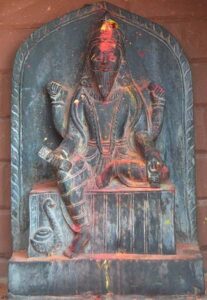
Vishvakarman, God of craftsmenship and lord of Chitra nakshatra
I have a new youtube video out on predicting beauty or ugliness in a natal chart. This is part of the ongoing Jyotish courses I am teaching on Patreon, but I decided to make this class free on youtube at the link above because its so easy to learn. It comes from three verses in the Upadesa Sutras of Rishi Jaimini. The other two sutras predict how to see speech disorders and dental karmas, and together they are part of a section on family and ancestral karma. I also cover that in this class as well. This class is a part of my ongoing Jyotish courses I am teaching through Patreon, and a part of the Jaimini sutras that I have most recently been focusing on.
I decided to make this astrology class free for the public as it is more of a simple, one off type of class that does not require a lot of prior experience to understand. Of cousre, all the other techniques you know about predicting beauty in the natal chart are also still going to be important, but you will find that you cannot see all of the karmic extremes of beauty or ugliness without using this simple technique. The main thing to remember though, is that in the Jaimini system we always use Rashi aspects. This may be the one thing that is unfamiliar to the average viewer.
Rasi Aspects, The Key To Jaimini’s System Of Jyotisha
These Rasi aspects, or “rasi dristi” are a key part of the Jaimini system, and are actually the most important aspects in Vedic Astrology. They are not commonly emphasized. There are actually 3 different types of planetary aspects we use in Jyotisha, and I have taught extensive videos on these three types and when to use which. Unfortunately most of those videos are paywalled but if you are a member of the Patreon be sure to review those if you get confused.
So here is the basic rule for understanding Rasi Aspects – All the movable rasis aspect all of the fixed rasis, except the one next to them. And all the fixed rasis aspect the movable ones, except the one next to them. And all the dual signs aspect each other.
For example, Aries, a movable (also called cardinal, or chara in jyotish) sign, is always aspecting the other fixed signs except Taurus, the one next to it. But Aries is always aspecting Leo, Scorpio, and Aquarius. And these same fixed signs are always aspecting back to Aries, and the other chara rashis, except the one next to them. So Scorpio is always aspecting any planets or cusps in Capricorn, Aries, and Cancer, but not Libra, the movable sign next to it. Then the dual signs, pisces, virgo, sagittarius, and gemini always aspect each other.
Thats all there is to rasi aspects. Now you will understand the examples when I factor in planets aspecting in the Jaimini system. I also explain the sutras on how to if one will have strange dental karmas, or have large or fanged type of teeth, or just teeth problems in general. The other sutra I cover shows how to predict speech disorders, including slow, stiff, or paralyzed speech.
For examples I use Brad Pitt, Angelina Jolie, Jennifer Lopez, Rosanne, Whoopi Goldberg, and some other clients from my private database. If you like this consider joining the Patreon to get access to all of my jyotish courses and videos, which is over 200 at this point. You also get a monthly forecast for each of the 12 signs.
I recently taught a course on the Atmakaraka and Svamsa of Jaimini. This is a unique system of vedic astrology that stands alone and was only recently rediscovered and properly reinterpreted in the last 15-20 years or so. This system is based on the atmakaraka and the “Svamsa” (The placement of the atmakaraka in the navamsa.) The sign of your svamsa (also called karakamsa but Jaimini never actually used that term so Svamsa is more correct) is in many ways the most important sign that defines who you are and what you will do in this world.
I cover each of the 12 Rashis and what Jaimini says the native will be involved in when his atmakaraka is placed in each of these rashis. It is quite a revealing and accurate system and it reveals the objective side of ones karma. It is also very simple and easy to learn.
In this course you will learn how to predict
If one will live in foreign lands or live abroad, or if other people in one’s life will be foreign or met in a foreign land, etc.
The overall nature of one’s dharma and career path and what they will be involved in with their life
How to predict various health issues such as obesity, leprosy, cancer, skin issues, psychological issues, digestion issues, etc.
The qualities of other people in ones life such as wife, mother, father, brother, and even what type of body they will have.
If one will be enlightened in this life
The quality of one’s afterlife
If one will be wealthy, successful, and/or famous
If one will have a great fall from a high place or a major accident in life.
And much more!
People that say astrology is too subjective have never studied the Jaimini system as I present it here. Through this course you will learn a lot of details about the signs that are not covered elsewhere. Through the Jaimini system we really learn to read the objective aspects of the chart.
There is nothing subjective about Jaimini, we use Parashara techniques for that. Jaimini tells us directly if we will be wealthy or poor, famous or not, married or not, etc. It is very black and white. I say that as a way to entice you but also to warn you, because you may learn things in this course that are a lot more concrete and real, and as a result may have to face more harder truths about yourself or others that you otherwise could ignore and keep running from in a less accurate astrology system.
If this course interests you check out my patreon where you can purchase this as a stand alone course for $108 or you can get it along with the Patreon membership for $33usd/month. This membership also comes with a free monthly forecast as well as discounted rates for one on one tutoring.
The tools I use as an astrologer and healer come from the yogic wisdom and insight of the astrology traditions of India. The techniques they offer, when properly used, help you see your past karma, your psychological wounds, and as a result what habits you need to change and where you need to go in this life to balance it out and be happy and fulfilled.
This is why it was called the “Eye of the Veda (truth)” and was traditionally the first thing Brahmins would be taught upon initiation.
In terms of Jyotish techniques, the systems I prefer the most are the Parashara and Jaimini systems. I have also been trained in Prashna techniques, ashtakavarga, varshaphala, vimshottari dasha, rashi dashas, and much more.
There are other tools and techniques that I use for reading the karmic condition and helping the client heal their wounds. Some of these tools could becalled yogic psychology. I also employ Adlerian psychology, guided meditation, creative imagination, human design, attitude adjustment, omen reading, the Chinese art of face reading (Siang Mien, Ayurveda, Herbalism, and Homeopathy.
Each case is unique. The remedies and advice given is never the exact same, but the Life coaching sessions usually employ some form of guided meditation practices that come from the Kriya Yoga tradition of Lahiri Mahashaya. I may share ancient and authentic yogic techniques that teach us how to develop control of the mind, and use our imagination creatively and constructively.
Human Design is a system that can be helpful in assisting the client to learn how to make better decisions and live a more authentic life. Ayurveda can also be recommended to help someone get back in tune with the seasonal shifts and environmental changes. Sometimes a visit to a homeopath or herbalist is advised.
The great thing about Vedic Astrology is we can see how true it is that different paths and remedies work for different types of people. One of the strengths of Jyotish is to show what other healing modalities are going to work for the native the best. Advice or remedies that work for one client may end up harming the next. Jyotish teaches us not to be seduced by our own experiences in healing, but to understand that different people are on different paths and need different medicines.
If you are interested in this type of work, Check out my readings and life coaching services to make the most of the new year.
If you are a wellness practitioner and want to increase your skillset and heal people at deeper levels than just treating the symptoms, consider learning with me through my Patreon and one-on-one tutoring sessions.
Numbers are seen quantitatively by the rational, left brain mind, and qualitatively by the subconscious, right brain mind. The secret meaning of numbers is at the core of not just Astrology but pretty much all the different occult systems that are based on numbers, which is most of them. The better we can understand the symbolic meaning of numbers, the better we can read the signs and omens that life and the universe is always communicating to us. This is real knowledge.
To understand the meaning of how to read tara bala nakshatra techniques as well as all that is in this diagram below, take this course.
As I was teaching the ongoing Nakshatra course I had to explain the tara bala techniques of nakshatra interpretation. As I was doing this I realized that I needed to teach an in depth class on numbers and their symbolic meaning in order for my students and myself to make the most of the Tara bala techniques I am sharing. Because the way to read nakshatras is all about this tara bala technique, and it only uses 9 places. Each of the 9 nakshatras from the birth star are a special place and then it repeats 3 times thru all the nakshatras. So it is like working with only 9 houses instead of 12 for the lunar nakshatra zodiac. This requires a lot of new education.
As a result, this short class somehow turned into a 3 hour mini course in itself on numbers. This is because there is a lot to numerology and numbers that 90% of the readers out there are not aware of. This material explains the connections and meanings of the 9 tara bala places from the janma nakshatra, as well as the meaning of the 12 bhavas.
What Is Taught In It?
In this mini course I explain not just the Vedic meaning of numbers 1-9 but also the pythagorean meaning, as well as how different occult number reading systems work like gematria, notarikon, and others. I compare and contrast where the Vedic world and the Greek/Pythagorean mystery schools agree or disagree on the different numbers, and why that may have come about. The Pythagorean mystery school teachings are also the basis of most of the reliable and authentic western occult wisdom we have. And the Vedic world is really the group that came up with the modern numeral system to begin with as well as the concept of zero. The arabic world is given credit for it in the modern day but they were working off of the Hindus older work.
This course offers foundational insights beneficial to readers of various modalities, including astrology, Tarot, and Human Design, making it valuable for anyone using numbers in psychic or spiritual practices. Even if you are just someone who loves sacred knowledge and is a big fan of Astrology and other 8th house topics, you will love this material!
It is available as a stand-alone mini course for $15 USD.
See my Patreon shop for more info and to see the other courses I am offering.