The etymology of words can be very fascinating, especially in the astrological context. A surprising amount of our old astrological knowledge has been forgotten in this current age; yet our very own English language still preserves clues to it, when we know the astrological language that birthed these words. See my previous blog on astrological word origins for more on this. One example I find fascinating is how in English speaking countries there is a negative saying about when someone is getting too curious about things that are not any of their business to be knowing about. We say that person shouldnt be “meddling in the affairs of others”. The word “Meddling” means to be intruding into other people’sbusiness, or to handle something in a careless way. It may have a latin root meaning “to mix” according to the Free Dictionary.
So to meddle in the affairs of others is to be concerned with affairs of others that aren’t really important and that often lead to unneeded gossip and trouble. This term is never used when one is genuinely inquiring about how they can help someone in a serious way. This term is used when one is more likely just curious and potentially seeking self-aggrandizement by comparing themselves to another.
The reason this is so interesting to me is because if there ever was a “meddle” or “likely to mix” type of planet, it would be Mercury. He is the most mixed and intermediate planet in many ways, being malefic when with malefic planets and benefic when close to benefic planets. He rules, is exalted in, and is fallen in ONLY dual signs (which have both masculine and feminine qualities), showing how pronounced his mixed nature is. Mercury is exalted in the earth sign of Virgo, which he owns. The main symbolic quality to remember with the earth element is its mixed nature. Each other element is just one thing, like water or fire. Earth is dirt, rocks, gaseous space, some water, and it is that mixed state that is important to remember from a symbolism standpoint. Mercury rules the Earth element as well, this most mixed element. Mercury is not male or female, but “neuter” or a more apt modern word for it would be Androgynous. (It is very interesting that from the ancient astrology standpoint there was an even spread of 3 female planets, 3 male, and 3 androgynous.)
Mercury also happens to rule one’s curiosity, and whether one has a healthy sense of curiosity, or whether they use this faculty to simply “meddle in the affairs of others”. A person with a weak Mercury may find themselves with a somewhat unhealthy sense of curiosity and can therefore get themselves into trouble with gossip or backbiting.
Let me elaborate on this point further. Mercury is very much in the middle of things, and he likes the harmony that being in the middle, or being mixed, can provide. He doesn’t like to choose a side, so much so that in a negative state mercury people are often stereotyped as “two-faced”, when they are usually just trying to maintain a good harmony with everyone they associate with, but may fail to really express how they truly feel to the person (which can cause problems down the line).
When it comes to our sense of taste, each planet rules one of the tastes, or “rasa” in sanskrit. For example the moon rules the salty taste, and Jupiter rules the sweet taste. Mercury rules the “mixed” taste, or the savory taste as we often say, and what is referred to as “umami”. This is what MSG (monosodium glutamate) is designed to replicate. The taste can be created from the mixture of different chemicals and so is not easily created without being “mixed” with a bunch of other chemicals, or tastes, we could say. Some examples of the umami, mixed taste of mercury would be the flavor that sauteed onions and garlic add to a dish, or the savory quality that tomatoes cause when cooked in dishes with other vegetables. The quality that aged wines develop is said to be umami. ( See Ernst Wilhelm’s Graha Sutras book for the best treatment I have found on the tastes of the grahas.)
Another example of Mercury being very mixed is the genders of the grahas (graha is the sanskrit word for planet). Sun, Mars and Jupiter are male grahas. Venus, Rahu, and Moon are female grahas. Saturn, Ketu, and Mercury are said to be neuter grahas. Again we see Mercury not necessarily choosing a side but preferring the mixed place. Also, each planet is given an avatar that relates to that planet; such as the Sun is correlated to Prince Rama, the Moon to Krishna, etc. Mercury is connected to the Buddha. What did the Buddha eventually end up teaching after experiencing all paths? The “middle way”….
Now we can see how this old phrase happens to match so well with what we know about the most mixed or “meddlesome” planet, who also happens to rule over one’s sense of curiosity, be it healthy or unhealthy…. Another saying in English to express the same sentiment is that someone is being “too nosey”. The nose is the organ of the sense of smell. Can you guess which of the five senses mercury rules?
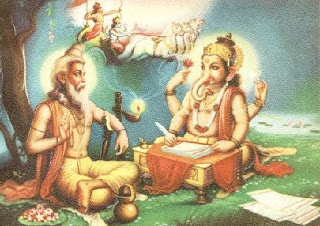
Sage Vyasa, compiler of the Vedas and son of Parashara, sitting with Ganesh
There are so many different types of people living in this world, with different temperaments and constitutions. It seems fitting that there would also be so many different types of spiritual paths, philosophies, or religions that are pursued. The horoscope of an individual can reveal many of the innate tendencies one may have towards spirituality.
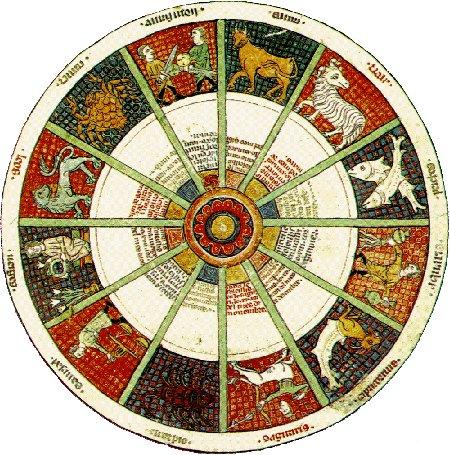
In astrology, there are five elements, Ether (space), Air, Fire, Water, and Earth. When it comes to the mechanics of the zodiac signs however, there are only four elements, with Ether being left out. I feel this is because in the context of earthly existence, space is always there, containing and holding all other elements. It therefore may not be as relevant as the other four when it comes to environments and places we go to, which is what the zodiac signs symbolize. Ether is the most spiritual element, being closest to the source, and the zodiac is the unconscious manifestation of Vishnu, keyword being “unconscious”. The signs therefore are not the conscious aspects of God, this is given to the planets. That is why the planets are deified and described as conscious beings. The signs are given the opposite distinctions, as animal signs, symbolizing the unconscious aspect of Maha Vishnu (God). It logically follows that the most conscious element (ether or akash) would be left out in the field of the “unconscious limbs of Vishnu” (the zodiac).
With that understood, it is important to see that each of the four elements of the zodiac signs has a certain nature, and is best able to approach truth in a certain particular way, which is most fitting to its own element. The different spiritual paths all tend to overlap the more they are practiced, but initially one will make the most progress by focusing on the mastery of the one that is most natural to them.
The air and earth signs are both more connected to the senses, and with actual manifested things. Because of this, they are inclined towards spiritual paths that help one see and realize God in the world, and not as some ideal or principle in life. The air signs often do well with a bhakti yoga (devotion) or karma yoga (selfless service) approach. The Earth signs do well with karma yoga, because they naturally want to be of service. If Mercury is strong and other intelligence yogas are present, then a jnana, or knowledge based path may work out also. The fire and water signs have more to do with ideas (fire) and feelings (water), which are more invisible things. These therefore, have more of an affinity for finding God as God really is, as a transcending-worldly-life experience, and not so much as a thing in the world. The fire element does well with paths that emphasize self control, such as raja yoga or kriya yoga, and also jnana yoga potentially. The water element does well with a jnana yoga path also as well as a bhakti path. The water signs are said to be the most spiritually developed, being Satya yuga rasis, and often they will be utilizing all or more than one of these paths, from what I have noticed.
As an example, a Leo has a fiery nature, and because of this, they are meant to act. The fire signs are the warrior caste, or the kshatriyas (pronounced “shaw-tree-ya”), and are the people on earth who are naturally inclined to lead, to protect, and to preserve and uphold the universal order or “dharma”. They do well with a raja yoga path, or a path that emphasizes purifying actions, discipline, and self control. Some may (with the best of intentions) emphasize to a strong leo personality the need to surrender themselves to God, and to see everything as god and renounce worldly life and actions in favor of serving a guru; in other words to set them on an initial path of bhakti. This can sometimes work out but many times it will initially go against the nature of a Leo and cause unnecessary confusion or aversion to the spiritual path… This is because for the Leo/Solar person, it is not the right time and place for that practice, and they don’t feel natural doing this. After doing a decade of raja yoga the Leo person may then be able to practice bhakti w great results, but initially this doesn’t appeal to a fiery nature, and it is better to get them on the right path quickly, to prevent any unneeded suffering.
It is important to follow the path of ones natural inspirations and inclinations. When we do things out of inspiration (sattva) those are the things that we will do for the rest of our lives, and so that is the best way to approach a spiritual path as well. If you want to make actual progress and not just have new ideas and terms in your mind to talk about, you need to find the path that is best for you and really anchors you to your destiny. People who change spiritual paths or religions frequently usually do not make noticeable spiritual progress in that incarnation. Paramahansa Yogananda said that it is better to dig one deep well when in search of water, than to dig several shallow wells. It is the same way with self realization.
One thing that astrology has been used for since who knows how long, is helping one understand their path in life, their dharma. Not everyone’s path will be like the typical “spiritual path” we may think of, but we all are on a path and in the greater context it all leads to the same goal, as all rivers flow towards the sea. This is what Jyotish can be so helpful towards. It can show us the path that is laid out for us, and help us see if we are being true to it or not.
Here is a simple technique to see begin to see how this works, but it does not show the full picture, and as such it should not be used as a stand alone technique, but in the context of the whole chart. The first house represents the person, and the ninth house represents the outcome of walking there path, and therefore represents the gurus or teachers that help guide one along their path in life. The first and ninth houses will always be the same element, and this shows us that each element has to approach their path and be guided along their path via a sign of the same element, their own nature, and not by another element. So if you have an Aries lagna, they are a fire sign, and are naturally oriented towards action, discipline, and protecting or defending what is right. The 9th sign from Aries is always Sagittarius, another fire sign. This shows that for Aries, its purpose is to act with that fiery inspiration that comes innately to it. Its gurus (the 9th house), Sagittarius, being fire signs themselves, will naturally encourage a spiritual path based on right actions, (such as a Raja yoga or Kriya yoga path) because that is what worked for them. This will generally work well for Aries, and to go and encourage a bhakti yoga path, or a path of detachment, is often “going against the grain” of an Aries personality. What is the point of being a warrior and defending what is good in life if even their Guru is telling them to surrender? Well….there isn’t much point to it, because a ram is meant to ram things, and when the Aries uses these thoughts as fuel and inspiration, he burns out quickly. That is not the path of an Aries. Aries is a warrior and is meant to fight the spiritual battle, which is why it is a fire sign and its 9th sign (its gurus and philosophy) is a fire sign as well. It is true that everything is God and that there is no real good or bad, from one perspective (and there will be other areas of this persons life that require that understanding). But from the Aries perspective it is really better to have healthy concepts of what is right and what is wrong, and to act with a belief in the purpose of life, and in acting righteously. When Aries follows its fiery dharma that is innate to it, it finds more fulfillment from walking its path in life.
Now lets take the opposite sign Libra, an air sign. Air signs are based on intellect, which is using one’s own sense perceptions to gather intelligence. This is different from Aries, which is a fire sign and based off of intuition. Aries just “sees” how it is. It just knows instantly, without the use of senses, which is the definition of intuition. Libra is not like this, Libra, and all air signs, use intellect, or the senses, to understand life. So each Libra will see an idea differently because of their own individual perspective in life, what their own senses have come to. The 9th sign from Libra is Gemini, another air sign, showing that the outcome of the Libras path is based on one’s own personal sense based intellectual understanding. This is why Libra does great with a path of detachment, or a path of bhakti (devotional surrender to God), because both of these approaches focus on purifying the intellectual perceptions until one begins to perceive God as manifested in everything. So for Libra, it is great for it to see everything as God, to simply surrender to God, and to have a sense of even-mindedness and detachment around what happens in life, and how one understands life. Libra is the 7th sign, the midway point of the zodiac, and as such, is the sign of karmic balancing. This is symbolized by the scales. The Libra is meant to weigh their experiences with detachment and understand that what is happening is what is being handed to them by life, to best balance out their karma. They shouldn’t fight it (but Aries should, remember). So the Libra does not have to “do” anything as much as an Aries does. The Libra has already been “doing” in its previous lives (when it was an Aries for example) , and is now coming to the stage of “accepting” one might say. Thus Parashara states that the best planets for Libra are Mercury and Saturn. These are the planets that are the most helpful for us to have a sense of detachment, and accept life how it is, so that we may best serve life the way we are meant to. And now we can see why a path of devotional surrender to the will of God (bhakti) or a path of detachment (jnana) are great avenues for the Libra to walk its spiritual path. If the Libra was to only follow a Raja yoga path, and renounced the world to go live in a forest and meditate unceasingly, this would only serve to enlarge the Libra ego by giving it too much focus on itself, rather than focusing on purifying the heart through love and service to others, which is the natural path of the airy Libra.
Hopefully these examples will give some insight into the value of using Astrology to help one understand the path in life they are walking. Each sign has its own particular path that is most suited to it in the rasi chart, the first varga, or divisional chart. That’s just the beginning though. In Vedic Astrology, there are 15 other charts that are used, and so there are many other ascendant signs, for many other areas of life, all with different elements and different outcomes. So different mental approaches will be better for different areas of life and for different people. The example given above is simple, but in actuality it can get quite complex when we start using all the other vargas, as well as the Atmakaraka.
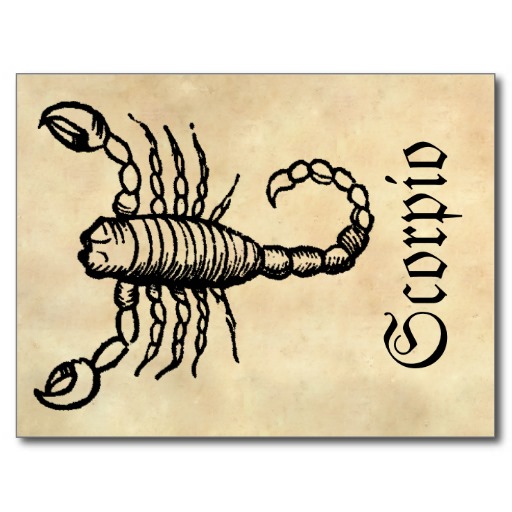
Its an interesting fact that during the 30 day period in which the Sun passes through the tropical sign of Scorpio (Oct 23rd-Nov 22nd), the United States, and many other nations celebrate five different holidays that deal with the main themes of Scorpio: death, and transformation.
These holidays are:
Halloween, originally known as Samhain
All Saints’ day
All Souls’ day
Remembrance day
Veterans day
Each of these holidays is centered around a major theme of the sign of Scorpio, and it really seems appropriate. Why? Because of all the different times of the year, this is the time when the Sun is passing through the sign of the scorpion, which only occurs once a year, like clockwork, during this 30 day interval. And as said above, Scorpio is the sign of death and transformation, so there is no better month out of the year to assign holidays that honor and direct the public’s attention to the dead. To fully appreciate this unique synchronicity, it is important to understand what the 8th sign of Scorpio deals with:
Scorpio has to do with the transformation of the soul, it is the part of the chart that deals with our longevity, vitality, and ability to fight for survival. It can represent actual battles as well as the spiritual, inner battles that we all fight between our higher and lower natures. It is the time of year right after Libra, when everything seemed peaceful and balanced, and the leaves were turning beautiful colors. Now in Scorpio it is getting colder and darker each day more quickly than before, and the leaves are all gone or rapidly falling. Everything is turning brown, beginning to hibernate, or dying. The theme is either turning within to transform and survive through winter, or die. Scorpio is the stage that has to do with the lack of nourishment in life, and the symbolic scorpion is meant to turn its energy, or “water” within to derive nourishment, hence it is a Brahmin sign (oriented towards enlightenment) and can set the stage for great spiritual development. This depends, however, on the nature of the planetary karmas that are involved. Difficult Scorpio related karmas show that one is not going to be able to find inner nourishment easily, and will likely turn to unhealthy ways of filling that void. This can lead to vices of all kinds. Here we see the origins of the negative associations of the sign coming in: Sex, abusive tendencies, addictions, breaking the law, drama, wild breaks and changes, and battles of all kinds.
If you are new to astrology, don’t expect to understand this most mysterious sign at first glance, it takes time and contemplation. For now just consider that the Sun (The soul of all) passing through the sign of death, the departed, and the transformations related to that, would naturally suggest that this is the best month of the year to honor the dead.
Halloween/Samhain – This was originally a Gaelic festival that marked the end of the harvest season and the beginning of winter, or the darker half of the Solar year. It is widely believed to go back to Pagan times before the Christian era. This was the time when the veils between the spiritual and material worlds were thought to be thinnest, and the fairies and spirits were able to most freely intermingle with the Earth realm at this time. Offerings would be left out for these spirits to honor them, as well as to ensure some degree of safety through the coming winter. According to some scholars, it was only after the Church condemned this whole festival that the fairies and spirits began to slowly take on a more sinister or wicked aspect. Now the “offerings” have been boiled down to kids in scary costumes asking for candy… If we choose to see it in its original context, however, it correlates to Vedic Astrology, as Scorpio is one of the three water signs (the brahmin signs). These signs are the most naturally oriented towards spirituality, and are the most psychically sensitive, with Scorpio being the one that is always considered most vulnerable to negative energies, or other worldly factors such as spirits, etc. {Note: To explain why this is would require a post in itself, but feel free to leave a comment if that is desired.}
All Saints’ Day – This is the day after Halloween, on November 1st. It is set aside to commemorate all the Saints known or unknown in the world. It is also refered to as All Hallows’ Day, or Hallowmas by Shakespeare. It is believed by many that this holiday was instituted to have a sort of Christian counter-holiday to the Pagan Samhain festivals at this time, and this is logical. Again we can easily see the connection to Scorpio, as Scorpio is a Brahmin Sign. Brahmins are the priests or saints of the ancient Indian caste system. This relates to the spiritual battles touched upon earlier. A Saint is really just someone who has won the spiritual battle that we all must fight eventually, between our higher and lower nature. In some respects, All Saints’ Day could be seen as a holiday that is honoring all the victorious Scorpios of the past, known or unknown.
All Souls’ Day/Day of the Dead – This is the day after All Saints’ Day, and is a day of prayer for the dead and especially one’s relatives. This is like All Saints’ Day, but more universal in that it is about honoring all Souls everywhere. Still a very similar Scorpio theme of death, and prayer, but with an added attention to family. The family connection makes sense as Mars produces our Siblings and Mother which is the majority of the family. Another interesting fact is that the 3 day period of October 31st- November 2nd is also a time in Mexico when a similar holiday is celebrated, The Day of the Dead.
Veterans Day– This is an official United States holiday on November 11th that honors people who have served in the US armed forces. Mars is the Lord of scorpio, and is the planet of war, and soldiers, and battles, as mentioned previously. Of course fallen heroes will naturally relate to the negative sign of Mars, and again we see a holiday that correlates as the Sun passes through Scorpio. Here we see a similar theme except that we are honoring those who have fought actual physical battles for the noble cause of defending their nation and freedom.
Remembrance Day– This is held on the same day as Veterans Day, November 11th, but is more international as it is observed by all Commonwealth of Nations states and it honors all those members of the armed forces who have died in the line of duty. There is a slight difference in that sense, as Veteran’s Day does not distinguish between honoring those who have served and those who have died. Still we see the same themes repeating that should be familiar by now.
Isnt it interesting that these five Holidays which focus on death and transformation happen to each fall in the one sign that is most appropriate? One naturally wonders if it is all just coincidental, because if astrological thought is correct then we should naturally feel these ways at these times… Or if it was intentionally arranged by Astrologers of Royal Families? Without evidence it would be hard to say. There is, however, no disputing the connection of these five holidays to the Tropical sign of Scorpio.
Astrology– “the study of the movements and relative positions of celestial bodies interpreted as having an influence on human affairs and the natural world”
Etymology – “the study of the origin of words and the way in which their meanings have changed throughout history”
THE INFLUENCE OF ASTROLOGY ON THE COMMON ENGLISH LANGUAGE
There are deep astrological roots behind the etymology of many of our commonly used English words. It is a funny thing how a word can originate and also how it can evolve. Take for example, how the word “cool” can mean something colder, or just something likable, which may even be hot in temperature. Quite a few of our common English words have origins or connections to Astrology, and I think this would be even more noticeably the case if the study of the heavenly bodies had been more tolerated during the rise of Christianity.
The skilled and competent Astrologers were some of the more knowledgeable people of their day in medieval Europe and Renaissance times, as well as in other cultures and other times. Its important to remember that in order to erect horoscopes before the time of computers, you had to have a great deal of mathematical skill and knowledge that simply would not be known, much less comprehended by the common man. Do you remember all that sign, co-sign and tangent stuff that had to be done in geometry class in high school to calculate arcs? What was the point of that? There really would be no point of learning that type of mathematical skill in the old days unless you were trying to make astronomical calculations dealing with calculating the arcs of planets, signs, and houses. And at this time astronomy and astrology were much more the same science, done by the same people. Add to this that to be skilled at the interpretation of a chart, you not only would have to be mathematically skilled, but would have to be also somewhat intuitive and quite subtle in your thinking. Hence, an astrologer is one who is naturally using both the right and left hemispheres of the brain, and using them together, and therefore someone who is developing their consciousness very actively. The study of astrology itself is of far greater value than an individual horoscope reading because of this reason. This is why it makes sense that the astrological community would have such an influence on the development of the English language, as not everyone was able to write, back in the olden days, and often it was only the educated folk that had this privilege. Many of these educated folk were astrological enthusiasts or were quite curious about the whole idea…There was no television or netflix back in those days. The myths and stories of the gods and goddesses were beautifully intertwined with the studied observations of the heavens, and this was and still can be a far more gratifying form of storytelling in my opinion.
Much of the great European scientists of the past were also practicing Astrologers, such as the obvious Johannes Kepler, a key figure in the scientific revolution who developed the first astronomical telescope and proved Copernicus’s theory of the planets revolving around the Sun. Kepler actually did do astrological readings for people professionally, and also had many interesting theories about the connection of weather to astrology. But this is often not mentioned in history books. Skeptics of astrology have even gone so far as to say that Kepler faked his astrology practice in an attempt to satisfy people when he needed to make money. It seems strange that people who respect this man would rather themselves believe that he was a con artist than a believer in astrology!
Kepler paved the way for Isaac Newton’s theory of universal gravitation. Newton was also an astrologer and an occultist, once being quoted in defense of astrology to Edmund Halley (another astronomer whom Halley’s comet is named after) saying “I have studied the matter. You sir, have not. ”
Galileo, the man called the “father of modern science” and “father of modern physics”, was also an astrologer, and further improved the Telescope, and also discovered the moons of Jupiter, as well as many other achievements.
Then when we look at the roots of European literature itself, the many plays of Shakespeare are full of astrological references, the most notable would probably be the term “star-crossed lovers”, from Romeo and Juliet, indicating lovers whose karmic conditions were not in harmony to produce an ideal relationship. Hence, their “Stars” were “crossed”. Also the character Mercutio should sound familiar, as he was not a capulet or romulet, and so moved freely from house to house (like the most mixed and dual planet his name is taken from). And lets not forget the famous warning that Caesar was given by the Astrologer to “beware the ides (middle) of March”. There are dozens and dozens of other astrological references in the plays of Shakespeare, and also in the The Canterbury Tales by Jeffrey Chaucer, both of which are actually a bit older than the renaissance time. These writings are classics of European society, and because of this they are very telling of what the intellectual community was interested in at the time. And language is such a funny thing, it adapts over time and changes so easily. Perhaps that is why the planet which rules speech and language, Mercury, is the most changeable and mixed planet. Mercury is also the name for a metal that is liquid at room temperature, and thus very changeable which is quite odd in the context of metals.
With all this in mind, I decided to put together a list of common English words that have origins that come from various cultures or other languages, but are astrological in nature, to help elucidate the point that astrology was so much a part of life to humans that it still can be seen in our speech. We should not be so quick to discredit astrology in our dawning scientific age, but remember that this was one of the original sciences and its influence has likely survived for a good reason.
I am no expert on linguistics or etymology, so I am unable to provide the source of many of these connections. Some of these I have read of, some I have thought of myself, and others I have been told by friends. Feel free to add any other astrological word connections you have noticed in the comments section below.
The Sun -soul- The latin word for the Sun is “Sol” which means “Sun”. This is where we get the word “soul” because the Sun represents the soul in the birth chart.
The Moon –Month-mind-man- the Moon revolves around the zodiac once each month, and is the reason we traditionally divide time up into months of roughly 30 days. This may come via the proto indo european root “menon”. This is also likely where the term “menstruation” comes from. The moons relationship to the menstruation cycle is well known. The moon is said to be the “Manas” (Sense mind) in Sanskrit. This is supposedly the root of the word “mind”, as well as “man”. Also the term lunar, used to indicate the moon’s influence, is the origin of the word lunatic, or looney. This is due to the well known influence the full and new moon has on our emotions. Anyone who has worked in an ER before can confirm that on full moons and new moons there are far more accidents, more domestic violence, more arrests, more burglaries, etc. It is because the Moon represents the ego-mind, and when it is full it is opposite the Sun, the true self, so our ego is furthest away and at odds with our true self. The earth is right in between this monthly sun and moon opposition, and in a sense, it is like we feel pulled strongly in opposite directions at this full moon time. If the entire ocean can be pulled in a direction because of the moon, it is no surprise that we can feel pulled to act a certain way we otherwise would not, when we consider that our bodies are 75% water.
Mars -martial-ire- From Mars we get the word martial,meaning war-like. This is obviously related to the warrior planet. “Ire” comes from “irasya” (“ill will”, Sanskrit) and is said to be related to “Aries”, the greek god of war.
Mercury -merchant-mercantile-migration- These words likely stem from the latin Merx. Mercury is a planet of travel, hence migration, and is of the vaishya caste, or the merchant class. He rules over artisans and the development of skills. Also, the word mercurial is obvious but worth mentioning, as it means something easily changed, or volatile, as mercury is the most changeable planet, as mentioned previously.
Jupiter – jovian-joyful- The roman word for Jupiter is Jove, and is the root of the terms jovial, and joyful. Jupiter is the most optimistic and positive of the seven grahas.
Venus – veneration-venison-venom- The proto Indo European root word Ven meaning “to strive after” is likely the origin of these words. Veneration means respect and awe for the greatness in someone, and a strong Venus helps us really appreciate the worth in an individual, so we can see the connection. Venison means “the game of the hunt”, and Venus represents what we desire. Venom is more difficult to understand the origin of, but perhaps it is because in some cultures venom is sought after for special rejuvenation properties. Venus does rule the bodies ability to regenerate and recuperate, so that is a possible, but speculative connection. Also some say that the English word Star comes from the Babylonian word Ishtar, the name of the deity they associated with Venus. This makes sense also because Venus is the brightest planet in the sky, and can look a lot like a star. Venus rules sexual intercourse and the number related to Venus is the number six. The latin word for six is sex, and so a sexagenarian is someone who is over sixty years old. We obviously know the term sex more nowadays as the term for sexual intercourse which is the domain of Venus.
Saturn-chronological-chronic-anachronism-chronicle- The Greek god related to Saturn was named Chronos, also known as the God of time. Saturn takes the longest to revolve around the zodiac at 30 years compared to the sun which does this in 1 year. Saturn therefore, rules over things that take a long time, and old things. His afflictions are said to stick with people for a longer period of time, due to his slow movement. Here we can see why Saturn rules over chronic illnesses. Also the word sapphire is said to come from the sanskrit “Sanipriyah” – meaning “precious to Saturn”, because he has traditionally been considered to relate to this gem.
another interesting one: consider- most likely from Latin con (“with”) and sider (“stars”), meaning “to consult the stars”. Originally this term meant only “to examine”. This implies how closely connected astrology was to important considerations of antiquity.
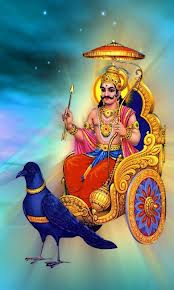
This post is about a very interesting talk that was given by Joshua Klein on Crows and their intelligence, on the TEDtalks website. It has particularly fascinating information for Astrologers, as the crow has a symbolic association with the planet Saturn, and this video unintentionally demonstrates that affinity very well.
The nine planets in Jyotish are said to produce all the many things in the world and in nature by mixing and blending their influences. Each planet is a “karaka”, or producer, of a particular concrete thing in someone’s life. For example, Saturn “produces” one’s servants. So in ancient times, if a King wanted to know how his servants would be, and whether they would work honestly and dilligently, or whether they would be dishonest and lazy, the skilled astrologer would look to the condition of the planet Saturn. The astrologer would look at other things too, but the producer of that correlating archetype in the physical world is very important. For learning about the King’s soldiers or ministers, we would look to Mars and Venus, respectively. There are many other factors the astrologer would look at, but this is perhaps the most important. Another way to say it is that one has to look at the planetary archetype that matches the physical entity in one’s life and “as above, so below”. So if there is a difficult Saturn “above” in the heavens at this king’s birth, then there will be difficult servants “below” in this person’s experience of an earthly incarnation. This is a foundational concept in the occult sciences in both the east and western cultures. It can be a hard thing to comprehend, so if it is difficult to grasp, just imagine it for now.
If you study astrology, then you probably know that crows relate to the planet Saturn and should watch the video first and observe the similarities yourself. If not, then you can read this list of congruencies and hopefully begin to appreciate this connection.
I will list some of the archetypal synchronizations I noticed below:
To begin with, the speaker, Joshua Klein, has a simple, intelligent, and capable look to him. These are the qualities of a strongly placed saturn. He wears a black t-shirt without a logo. Saturn is related to the color black, and is mythically said to have a black or dark complexion. He even tells a bit of a “dark” joke about the Alfred Hitchcock movie, The Birds. These traditions of Saturn relating to the color black is still evident in the Jewish tradition, where on the holy day, the Sabbath, they traditionally where black. The Sabbath is Saturday, which is the day of the planet Saturn. The spelling makes it obvious, but all the days of the week are actually related to the planets.
He says that he began his interest and research in crows when a friend at a cocktail party tells him that they are useless and should be killed. His very saturnian response to it is that they could probably be trained or used in some way that is more helpful for human life. This is very evident of a strong Saturn, while Joshua’s friend displays the typical pessimism of a poorly placed Saturn, Joshua says “no”, and decides to think differently about the matter. Saturn’s astrological role as a planet is to help that person become who they need to be so that they may do what they need to do to help the world the most. So right away Joshua is looking at what could be viewed as an annoying pest, and seeing how it could potentially be turned into an animal that actually makes life more bearable and enjoyable.
At about 3 minutes into the video, he shows an amazing clip of a crow bending a metal wire into a hook to get a worm out of a tube in a science experiment, which the crow had never seen done before, showing great ingenuity and inventiveness. At 4 minutes in, he states that the brain of a crow is in proportion to the brain of the chimpanzee. Saturn is found well placed in the charts of Inventors and people who are somehow improving the quality of life for everyone.
The clip of the crow at the five minute mark, with its clever trick of letting the car crack the nut for it, demonstrates patience, a key attribute of Saturn. Taking 30 years to go through the zodiac, it is the slowest of the main planets, symbolizing patience and endurance. A squirrel would never be able to wait that long. Also, it is said that the difficult karma that Saturn brings out in a chart can tend to afflict one the longest, because of its slow movement through each sign over 2.5 years. Sounds familiar to the story about the crows hassling the scientists, and remembering them even months and years later!
He makes a strong point overall about how crows seem to actually benefit from cleaning up our human societies messes and roadkill, and that when trained can actually help us clean up debris from events or find lost change. Saturn’s role in the medical aspect of astrology is quite similar, ruling the immune system. Saturn is the planet that is responsible for removing waste from the body, keeping off disease, and is said to rule our longevity. Here we see evidence that crows are cleaning the city streets in an analogous way.
Overall I think this video is fascinating even without respect to Jyotish, but for those with interest in astrology and mythological symbolism, you can see there is much to be appreciated between the Crow and the planet Saturn. And by appreciating the symbolic value of our environment and the life around us, we can feel more like we are a part of something greater than our little self. In this way, mythological symbolism can have therapeutic properties for our minds.
If you notice any other interesting astrological correlations between the behavior of crows and the symbolism of the planet Saturn, please share below in the comments section.
Photos: Mythological image of the graha Saturn, said to ride upon a crow or vulture.
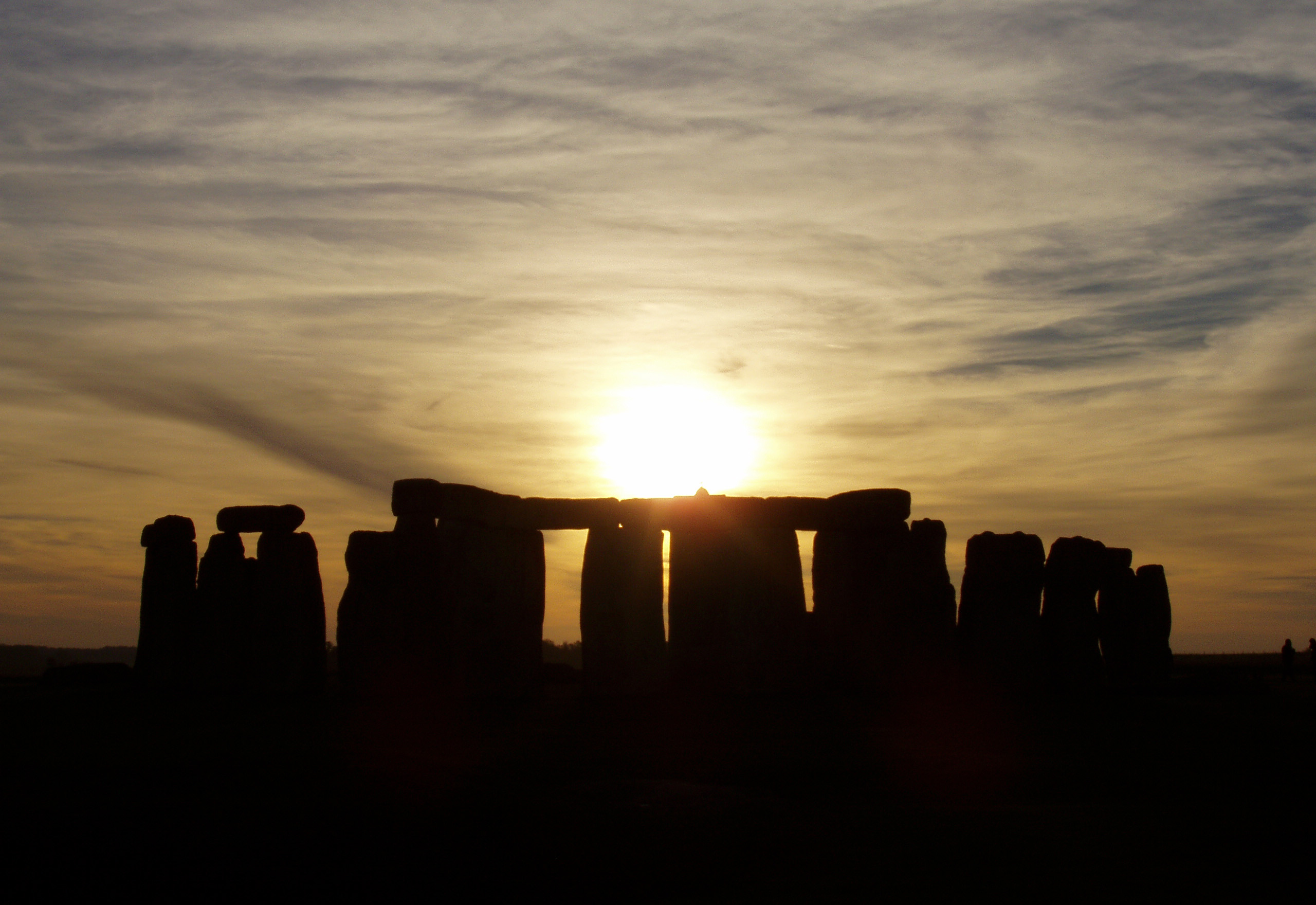
When we look across the globe at many different cultural traditions, there seems to be an emphasis on the importance of the astronomical periods known as the Solstice and Equinox times. Many of the most ancient landmarks that have ever been discovered, such as Stonehenge, Newgrange, the temple at Karnak, Macchu Picchu, and Chichen Itza have all been oriented to these four points, the winter and summer solstice, and the spring and fall equinox.
Why is that the case? Well, we may not know all the reasons why. Historians point out that these times needed to be known in order to know when the seasons were coming, to know when to plant seeds, and to know when to harvest them. So there is likely a practical reasoning behind it, but there also seems to be a profound spiritual logic behind the awareness of these four times. In this post I will try to clarify the importance and meaning of the astrological and astronomical significance of the solstices and equinoxes, which have been called the “Celestial Cross”.
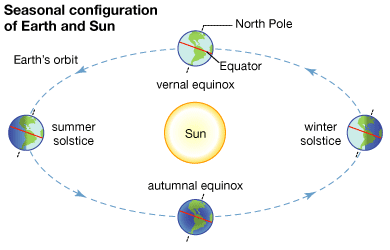
First lets clarify what these terms “Solstice” and “Equinox” actually mean. The Solstice is an astronomical event that occurs twice each year as the Sun reaches its highest or lowest point in its apparent year long course across the equator and back down. And the equinoxes are the two middle or “equal” points that the Sun hits as it goes up and down across the ecliptic as we see it from the Earth. The Equinoxes are the exact days when the day and night are of equal length.
(Note: Astrology is an Earth based science, and as such, it is not important whether the Earth actually is moving around the Sun, or the Sun around the Earth. The symbolic importance is what appears to be happening from the perspective of being on Earth. So we say that the Sun moves north and south, even though it is commonly understood that the Earth is what is moving around the Sun. From the perspective of the relativity of motion, it really cannot be proven that the Earth is moving around the Sun, as the entire Universe could equally be said to revolve around the Earth, as the famous physicist Ernst Mach has contended.)
THE VERNAL EQUINOX
The vernal equinox is usually around March 20th of each year and marks the beginning of “Spring” as we commonly call it. This is astrologically the beginning of the sign of Aries, “the ram”, and the beginning of the Sun’s course through the Zodiac again. As this is the point where there begins to be more daylight than night, and all of nature begins to awaken and “spring” up from dormancy, we can see why this is symbolized by a ram. Rams are powerful and fearless creatures that climb mountains and smash into their enemies head first. They push the boundaries of what can be possible. We can see how this fits as a perfect symbol for the time of year when nature itself seems to awaken and burst forth into activity. Aries individuals are very comfortable with this sort of activity and are courageous, adventurous, pioneering, and love initiating new projects.
THE AUTUMNAL EQUINOX
The autumnal equinox is the exact opposite point of the solar path, and marks the first day of “Fall” or “Autumn”, and is astrologically the first day of the sign of Libra, “the scales”. Libra is the sign of the balancing scales, and that should make sense to us as we now know that this is the middle point, or “balancing point” of the zodiac. Naturally Libra is a sign that seeks balance, equality, and harmony, and we can see the logic behind that, in the Sun’s yearly course. Also, Libra is the sign where the Sun is weakest, and the weakest sign for a planet is referred to as its “fall”. Its as if the planet falls from its natural strength at that place. Hence, we call this time of year, “The Fall”, as it is the time when the Sun “falls” astrologically, but also this means in actuality that the light on earth is diminishing more quickly each day as winter approaches. So the fall equinox marks the equal point of the Sun’s descending path, after which there will be more darkness than light for 6 months.
THE WINTER SOLSTICE
This brings us to the Solstices. After the autumn equinox, the next major change will be at the winter solstice, which occurs on December 20th or 21st. This is the shortest day of the year, where the Sun is seen from Earth’s perspective as being the furthest away and dimmest that it will be. If one is far North enough above the equator, then the sun can appear to disappear or not even rise on this day. At the north pole, the sun does not rise at all. For three days the sun’s path stays the same, and so in the northern regions of Earth, the Sun is apparently gone (or barely visible) for three days after the 21st. Then on the 25th of December, the Sun rises just a bit further North, and is just a bit more visible, and the day is just a bit longer. This day marks the beginning of the Sun’s 6 month journey northward across the equator and the beginning of the longer days. This winter solstice point is astrologically the first day of Capricorn, the goat-fish in western tradition, and the crocodile in the Indian tradition. Both symbols represent the same energy of coming from darkness into more light. The crocodile is often half submerged when seen, and lays low but can be quite powerful and fearsome when it moves up onto dry land. This fits the nature of this time, when the Sun is most hidden, but is beginning to make its journey towards more light. The goat or goat-fish in the western tradition, has the same symbolic meaning. The fish-half can represent the submerged, hidden, or darker emotional aspect of ourselves or our karmas that can sometimes surface during the winter time. The goat, being a natural mountain climber and survivor, symbolizes the inevitable rising up into life and light of the Sun on its 6 month journey that begins at this stage of Capricorn. The goat will always make it to the top of the hill eventually, but may take its time. This is how capricorn natives behave, they are focused on long term goals, security, moving up in the world, and on metaphorically “getting through the winter”.
THE SUMMER SOLSTICE
After 6 months of the Sun moving north, it reaches its peak of northern movement on the summer solstice on June 21st. This is the brightest day of the year, and the Sun is as far north as it will ever be. For 3 days the Sun stays at about that same place, just like the opposite winter solstice. Then on June 25th, the Sun actually starts descending and moving south. This is astrologically known as the sign of Cancer, the crab. And as crabs are easily seen to side-step as they move, this is exactly how the Sun behaves here. The sun was moving north, north, north, then it stops at cancer…. and then side steps for 3 days, and then retreats back south, like a crab running back to its hole in the sand. Cancerian individuals are known to be a bit fickle, and often dont address issues head on like the ram, they tend to pause and side-step around the issue if possible. They are able to yield to the moment, and enjoy receding from the world into their home or something they are comfortable with. This makes sense as this is the point at which the Sun actually stalls and yields from moving any further north, and then changes direction, and begins to move south. Cancer natives are very receptive and are similar in that they can stop and check in with their emotions and say, “is this the right course for me? Perhaps I should change the course”.
Hopefully it is beginning to make sense that this course of the Sun, along with the Moon’s monthly course around the Earth, are the cycles that create our seasons and therefore our sense of time and rhythm as we live on Earth. That is very important! It makes sense that these cycles will also have a big influence on our psychological states, and this is obvious when we take even a basic look at the signs that are associated with the four major points of this solar cycle, as we did earlier. These four major points that correlate to Aries, Cancer, Libra, and Capricorn are places where the Sun and the Earth are in an alignment, and so naturally we would assume that these signs would have importance. And even those with a basic knowledge of astrology know that this is true, as these four signs are called the “cardinal” or “chara” (changeable) signs. These cardinal signs are naturally the most active, and the most changeable. This makes sense as these are the actual points where the sun “changes” its course. The Sun represents the “Soul of All”, or Saarva Atman, as discussed in a previous post. Logically it makes sense that if these signs are where the Soul of everything changes its course, the people born under that sign will also be more likely to change course throughout life, and be more comfortable with change.
We can also think about this and see that it is likely not some star constellation that looks like a ram that is making an aries person so impulsive, but the very framework of the Sun and Earth’s movement (these equinoxes and solstices) that is the factor. This makes more sense when we contemplate it, as stars can burn out or appear in different areas over time, but the Sun and Earths relationship appears to be much more consistent over the long term, and hence a better framework for time.
We have been dealing with these cycles our whole lives, so we may not notice the effects from day to day, but these cycles can definitely be noticed and felt to varying degrees, depending on the consciousness of the person experiencing them. This is a very important pattern and the ruins of ancient cultures across the globe are all aligned to this “celestial cross” as it has been called. In the next post about the Solstices and Equinoxes I will elaborate more about the spiritual and yogic symbolism of this same cycle.
“The Moon reflects the Sun’s light and it does not emit its own light.” -Rig Veda 1:84:15
“The Sun is the upholder of all light. The Moon and all other planets do not possess light of their own. All of them shine with the light of the Sun.” -Atharva Veda 14:1:1
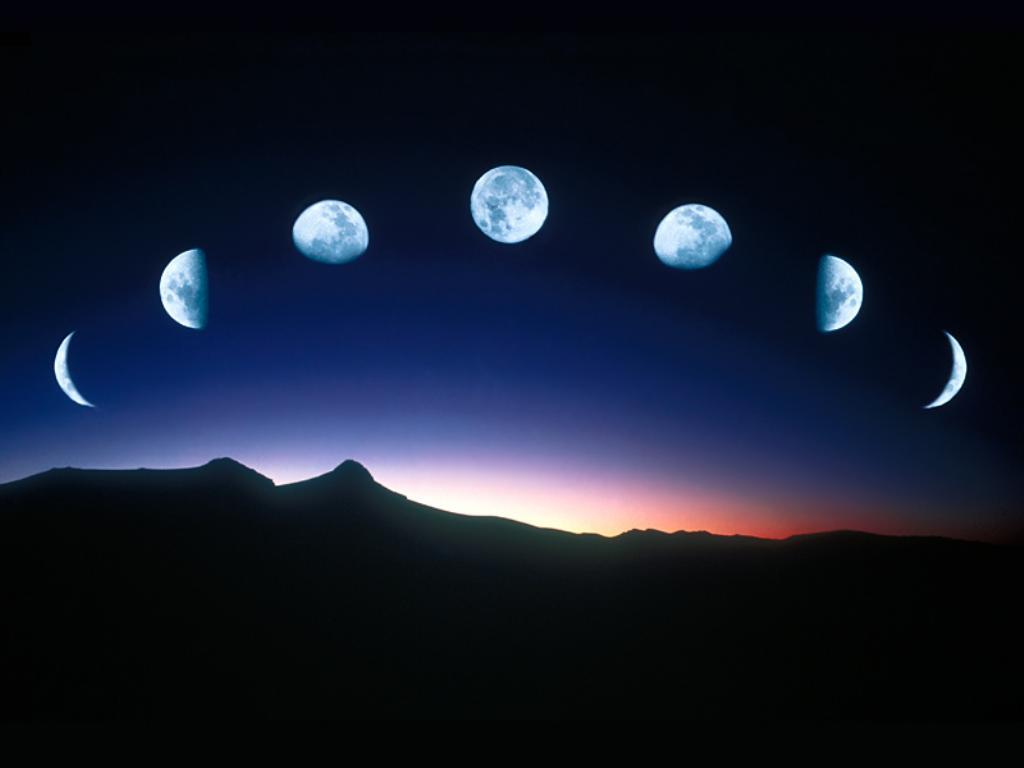
The Moon is the brightest object in the night sky. With its fascinating luminescence and mysterious waxing and waning behavior, it is no surprise that it has been the subject of great interest for practically every culture on the planet. It has probably been an object of contemplation ever since humanity expressed such an ability, and for good reason, as there are so many interesting qualities to appreciate about this luminary body.
To fully understand the Moon, we must first look to the Sun, the other great luminary, and the source of the moons reflected light. In Jyotish (vedic astrology), each planet represents an aspect of our own self. The Sun is the symbol of the real Self (note the capital S, referring to our eternal Self or Soul, not the impermanent and always changing personality self). As the body that the rest of the planets revolve around, it signifies the real and eternal “Soul of All”. The Sanskrit word used to describe the sun in this context is “Sarva Atma”. “Sarva” means “all”, “of all”, “everything” and “all things”. “Atma” means “soul” or “self”. So the Sun is the life of everything. All is one with the Sun at the deepest level of existence. The Sun relates to that pure consciousness that manifests everything in existence. Mathematically, the Sun is like the number 1.
The Moon is the other main source of light and luminescence in our world. As the above quotes from the ancient Rig Veda and Atharva Veda explain, the moon has no light of its own, and is merely reflecting the Suns light. In the Indian tradition of astrology, the moon is the planet (astronomically it is considered a satellite, but for astrological purposes it is considered a planet, as it behaves like other planets from our perspective on Earth) that represents the ego-mind and the incarnated human being. It is the reflection of the Sun, the Supreme Self. Human beings can certainly be reflections of the Supreme Self, but not all the time, just like the moon, who can sometimes be full and reflect the Suns light perfectly, and other times be so dark it cant even be seen. The sanskrit word given for the Moon is “Manas”, which means “mind”, but not in the western sense of the mind as the intellectual processor, but as the thing that is experiencing life. The mind is what experiences life through the five senses. Interestingly, because the English language has roots in the Vedic Sanskrit language, this Sanskrit word “Manas” is the root origin of all three of the English words “man”, “mind” and “moon”.
When we think about the Sun, how hot and bright it is, how intense and draining it can feel to be exposed to it for long stretches of time, it can be easy to feel overwhelmed by it. Just as Man cannot easily perceive the Sun for more than a moment without having severe eye damage, he likewise has difficulty perceiving God in daily life. It really is logical to correlate the Sun with the Supreme Self, or God, as it is the sustaining source of all that is living in our world. Its course is so regular and unchanging, and we live our lives by it….yet we cannot understand it or even look at it normally. Life cannot exist on Earth without the support of such a powerful solar body.
In the same way, when considering the Moon, its constant waxing and waning, changing signs, moving to and fro, and occasionally being eclipsed… It is much more symbolic of a human beings awareness. We wax and wane, have good days and bad, seem to go through cycles we have little control of and in an overall sense are very changeable by nature. Hopefully this symbolism is making itself clear now. Our ego-mind is just like the changeable moon. The ego-mind can be thought of as merely a composite of personality characteristics, that we do or do not like, that are taken from a VAST amount of experiences we have had. So it is always changing as well, as we have new experiences and out grow old experiences that we previously identified with. For example, someone may not like spicy food, but then one day they have a delicious spicy soup in just the right quantity, and fall in love with it, and how it makes them feel. Then their ego mind will say, “Now I LIKE spicy food”. Their ego has changed and adapted just like the ever changing moon.
And that brings us to another interesting thing about the moon, or ego-mind; its adaptability. Each planet is said to relate to the other planets as being a friend, neutral, or enemy to them in the Vedic system of astrology. And these relationships are based on the natural energies, or “rays” of each planet. Like how certain colors just go well naturally, and others “clash”. And when it comes to the moon, it is the only planet that has no enemies, only friends or neutrals. All the other planets have at least one, two, or three enemies. What does this tell us about the ego-mind? Contemplating this reveals many things, but particularly significant is that the moon, or ego-mind, will latch on to and feel comfortable with anything it can in order to survive as the individual ego. Even if that thing is not good for it and harmful. This is why the separate egoic sense of self is such a source of pain and suffering. It will not refuse identifying with even the worst elements of life in order to keep growing and experiencing. The Moon with Jupiter for example, is showing that a persons mind is comfortable identifying with Jupiterian things such as knowledge, wisdom, a sense of purpose in life, and optimism. The Moon with Saturn, on the other hand, shows a person identified with suffering, pain, lack, hard work, and the difficult sides of life. Oftentimes they will actually be somewhat comfortable with the painful sides of life. They will be used to struggling, and enduring. When things are going great in life, they may actually think, “something isnt right”, but it is because they just are not as used to life going so easily. The Jupiterian-moon person may be the opposite, and when life is going right, they will stop and think “life IS going right”. This shows us that some things are naturally more beneficial for us to identify with than others, but if we decide to, we can latch on to even the harshest aspects of life, in order to keep growing and experiencing life as it is happening…
The moon, or mind, can therefore work out well for a person, or not so well for a person, depending on what they are identifying with, as revealed by asessing the moon in a horoscope. But either way, whether ones mind is more comfortable with wealth or poverty does not change the fact that they are identifying with a temporary and changeable sense of themselves, which waxes and wanes. It is still not the real Self. So from the Yogic viewpoint, identifying with this passing sense of self that one is comfortable with can bring happiness or sadness, but will still invite suffering to the “moon-identified”, or ego-minded person, until they are able to become “Sun-identified”, or “Soul-minded”. We know already that the Sun is the “Self of all”, hence the emphasis on “Self-realization” from the yogis and enlightened ones.